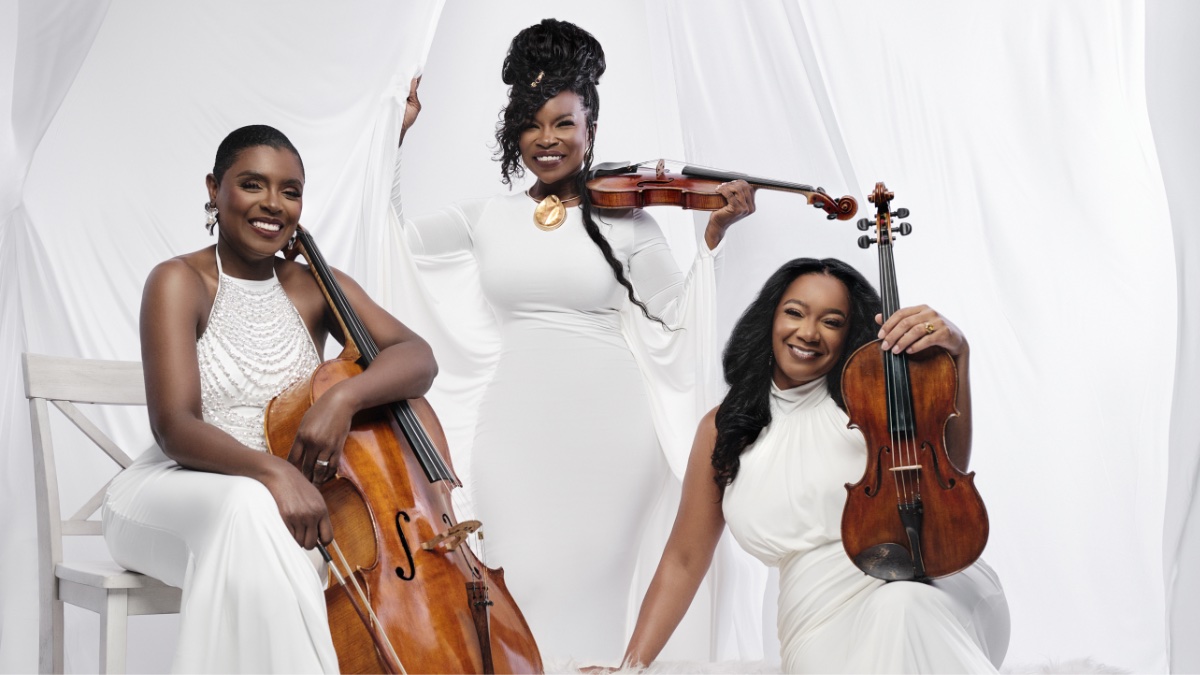
The String Queens aren’t just releasing a song — they’re lighting a fuse. “Troubled Liberty” is their boldest strike yet: a searing blend of ancestry, protest, and unshakable Black womanhood that refuses to whisper when the moment demands a roar. Born from spirituals, sharpened by classical rigor, and ignited by the chaos and hope of America right now, the piece doesn’t ask for permission — it claims space. Dropping it on Juneteenth is no coincidence. It’s a proclamation: freedom is unfinished, the struggle is alive, and The String Queens are here to soundtrack the fight.
What inspired The String Queens to create “Troubled Liberty,” and how did the concept take shape musically and thematically?
Kendall: We knew our next project needed to be rooted in ancestry, reverence for the past, and a response to what’s happening in the world now—the need for more love, unity, and truth about what we carry as Black women. The piece began in Dawn’s basement last September, with Elise playing these dark, mysterious chords that still felt hopeful. My entrance is a darker version of “My Country, ’Tis of Thee,” a song that has always mystified me lyrically. We wanted the opening to feel stark—like, “What am I about to experience?”
We were also inspired by a virtual event we did with Nikki Giovanni during the pandemic. She compared us to the “hidden figures” who helped put the first American man on the moon, and that connection to ancestry stayed with us. The title came much later, after we’d lived with the piece for months.
Dawn: A major inspiration was juxtaposing Negro spirituals with American patriotic melodies—”My Country, ’Tis of Thee” against “Wade in the Water.” That contrast leads into an original melody we created together. As Black women, we’re often expected to mute our feelings, so this piece became our emotional statement and a tribute to the Black women who came before us, including Nikki Giovanni and Regina Carter, who co‑produced the single.
Elise: There’s also a deeply spiritual element. A videographer recently asked what the “other melody” was besides “Wade in the Water“—he didn’t realize it was an original line Kendall brought in from her soul. It feels like a cry, and it fits the mission of the piece. The work moves from darkness to hope and ends with a question: Where are we now?
Why release your first original composition on Juneteenth, and what does that timing mean to you as artists and educators?
Dawn: This piece represents freedom, liberation, and the idea that we don’t need permission to express ourselves. That’s the message we want to pass on to young Black and brown musicians — you don’t need anyone’s approval to claim your artistic freedom.
Kendall: Juneteenth is about freedom but also community. We all grew up celebrating it and understanding its history. As educators, we want our students to know they deserve to exist fully — not because they’ve earned it, but because they’re here. Releasing “Troubled Liberty” on Juneteenth felt right because the piece is about honoring the past while acknowledging the unfinished work of freedom.
The title itself came from community. We performed the piece live before naming it and asked audiences to share what came to mind. Over months of shows, people emailed, DM’d, and told us their reactions. “Troubled Liberty” emerged from that collective experience.
Elise: To me, releasing it on Juneteenth makes it an anthem of resilience, freedom, and joy. The piece moves through all those emotions.
Dawn: We’re performing it this Juneteenth in Peoria, Arizona—a city that’s over 75% white. We often play in places where audiences may be unfamiliar with Negro spirituals or with string music outside classical traditions. That’s part of our responsibility: to teach, to unify, and to show that these musical traditions can coexist.
Your work spans classical, jazz, gospel, R&B, and contemporary styles. How did those influences come together in this piece?
Kendall: Our sound is rooted in soul—everything from Negro spirituals and gospel to Motown, Michael Jackson, the Beatles, and even the Dawson’s Creek theme. It’s the music we grew up hearing in the car or at home. “Troubled Liberty” continues the work we began with “Till Victory Is Won” and our “Spirituals Medley.” Classical technique is our foundation, but we can’t separate that from our heritage. We bring our Blackness and our souls to everything we do.
Elise: The piece started with a simple cello drone. We were all in a reflective, ancestral, spiritual space. We built the composition slowly—adding, removing, and refining. The final work holds mourning, joy, and hope. It took weeks because we’re intentional about how we present ourselves to the world.
Dawn: Technically, the piece reflects our training. The opening drone has no vibrato—very Baroque, very Bach. Then it opens into a fiery, soulful melody full of vibrato and emotional intensity. That contrast mirrors our backgrounds: classical discipline blended with improvisation and Black musical traditions.
As Black women in classical and genre‑blending spaces, how do you see your role in shaping America’s musical landscape?
Kendall: We hope that one day school orchestras will play “Troubled Liberty” and feel empowered to create their own compositions. People often don’t know where to place us—classical, soulful, or improvisatory—and that uncertainty reflects our mission. We’re our own genre. We want to break the idea that string music belongs only in Eurocentric concert halls. Our sound invites everyone in.
We’ve even experienced pushback — like when uniformed officials questioned us during our video shoot and asked us to stop. That moment embodied the “troubled” part of “Troubled Liberty“: freedom exists, but justice isn’t fully here. The piece intentionally ends without resolution. We’re okay leaving listeners questioning.
Dawn: We think about artists like Michael Jackson, Beethoven, Jon Batiste, and Nina Simone—people who pushed boundaries and stayed rooted in culture. If we continue moving with authenticity, faith, and community, we believe we’ll land in a powerful place in American music.
Elise: When I listen back, “Troubled Liberty” feels like a soundtrack—a visual experience. You can almost see the joy, struggle, and history in it. It marks a meaningful place for us in American music.
What changed for you artistically when you shifted from interpreting existing works to creating an original composition?
Elise: It was time. After years of interpreting others’ music, we were ready to put our own stamp on American music. People kept asking if we had originals, and now we finally do—something that expresses our soul.
Dawn: A turning point was when Regina Carter joined one of our writing sessions and encouraged us to be completely free. Creating an original work is deeply personal and vulnerable—it has to come from within. It took eight or nine years for us to feel fully grounded in our collective artistry to take that leap. You can’t force an original composition; it has to mean something.
Be’n Original