dream hampton and Petter Ringbom discuss how the fascinating documentary, This World Is Not My Own, reimagines the history, creative genius, and legacy of self-taught artist Nellie Mae Rowe.
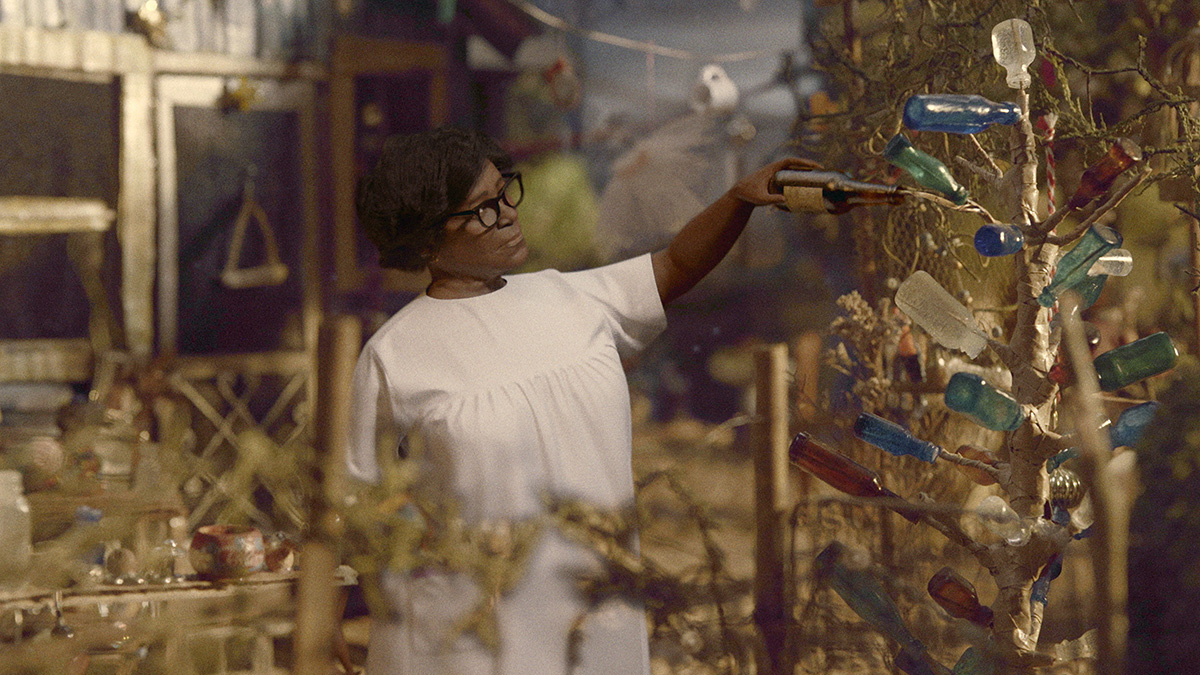
Before museums, retrospectives or the language of legacy arrived, Nellie Mae Rowe had already built a universe of her own. Inside the Georgia home she called her “Playhouse,” the self-taught artist turned everyday materials into dolls, drawings, sculptures, and spiritual declarations, creating a world so alive it seemed to resist the limits placed on her by history. In This World Is Not My Own, directors Petter Ringbom and Marquise Stillwell do not simply recount that world; they step inside it, using documentary footage, animation, and scripted scenes to honor an imagination too expansive for a conventional portrait.
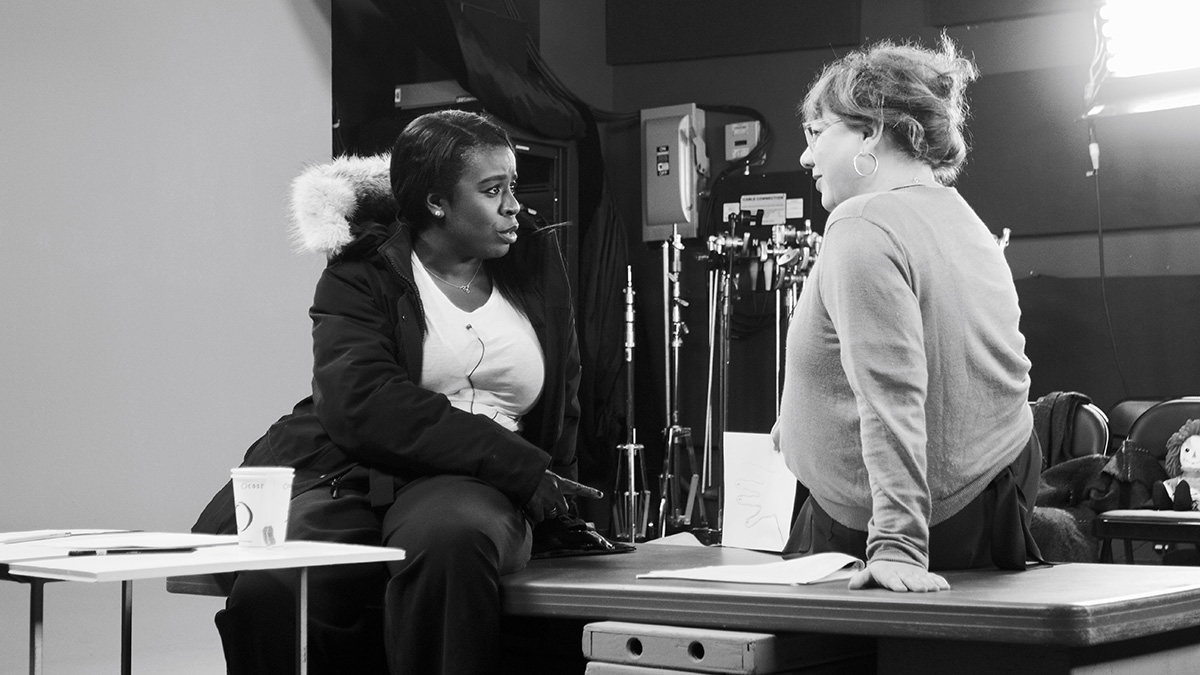
The feature-length documentary, produced by Ruchi Mital with dream hampton among its executive producers, has drawn attention for treating Rowe’s life as both history and living imagination. The film’s own materials describe it as a portrait that mixes traditional documentary techniques with animations and scripted scenes, reimagining Rowe’s “Playhouse” and working with three-time Emmy winner Uzo Aduba and Broadway veteran Amy Warren to bring Rowe and gallerist Judith Alexander to life.
For Ringbom, the project began not as a conventional commission but as an invitation to think bigger. The Judith Alexander Foundation, connected to the estate of Rowe’s gallerist, first approached him and production partner Marquise Stillwell about making something on Rowe’s life. “I think they had sort of envisioned maybe a shorter film for Georgia Public Television,” Ringbom recalls. “And we felt that if we’re going to make this, that we should really be ambitious.”
That ambition became a film that does more than revisit an overlooked artist. It participates in the larger work of restoring Rowe to the center of American art history. As hampton explains, “What drew me to This World Is Not My Own was that it’s much more than a documentary about an artist. It’s about, it’s art itself.”
Reclaiming a Life in Full Color
hampton admits that she did not know Rowe’s story before Ringbom and the film introduced her to it. That discovery became part of the film’s urgency. Rowe, who did not receive broader art-world recognition until late in life, now speaks directly to contemporary questions about visibility, value and cultural memory.
“Although she lived in the 20th century, as did I, but you know, born in 1900, her story still feels incredibly contemporary,” hampton says. “She created her own world when the world around her often excluded her or underestimated her.”
For hampton, Rowe’s late recognition is inseparable from the broader conversation about whose stories are preserved. “Today, right now, we’re having important conversations about whose stories get told, whose art gets valued, and whose voices have historically been overlooked,” she says. “So the film helps correct that.”
Rowe’s work has since moved through major cultural spaces. The documentary was developed alongside renewed institutional interest in her practice, including Really Free: The Radical Art of Nellie Mae Rowe, a major exhibition that opened at Atlanta’s High Museum of Art before traveling to institutions including the Brooklyn Museum.
Ringbom sees that afterlife as one of the film’s most meaningful achievements. “This kind of like the idea of a film can affect not only the people who are watching it in the audience, but can have an effect on the legacy of an artist like Nellie Mae Rowe in a broader sense,” he says. “It was incredibly gratifying and maybe the thing that I’m the most proud of with this project.”
Entering the Playhouse
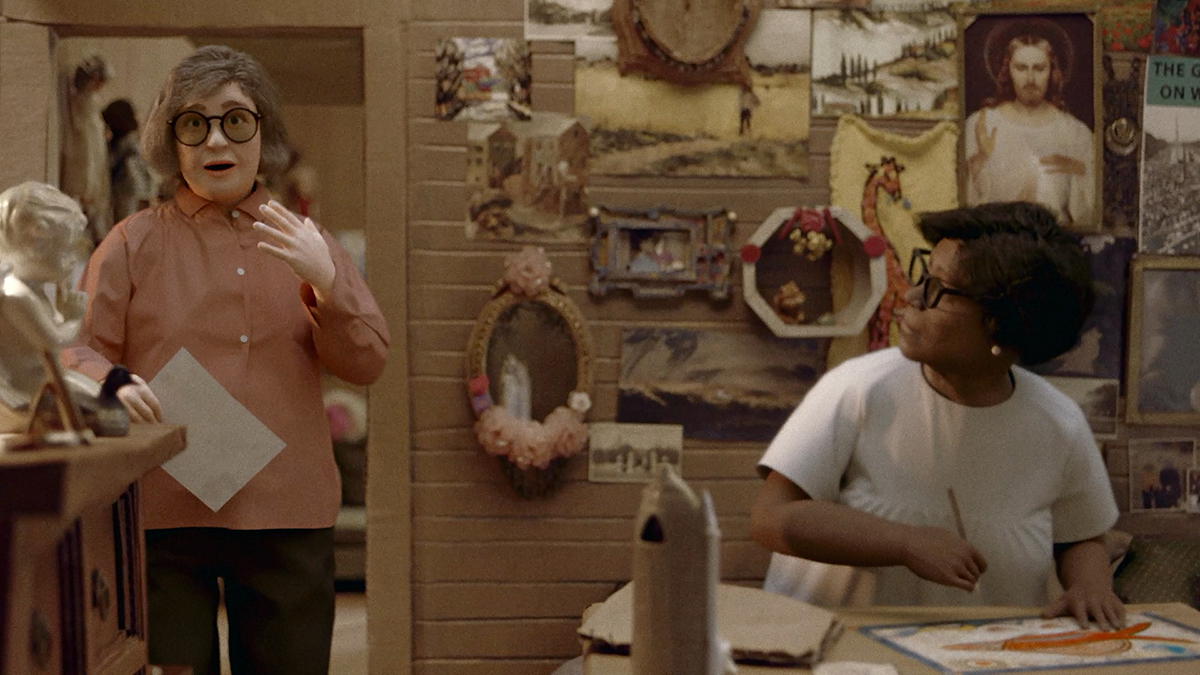
The film’s hybrid approach grew out of a practical problem: there was very little archival material. Ringbom says nearly every photograph and every second of footage of Rowe appears in the finished film. Rather than treat that absence as a dead end, the filmmakers used it as a creative opening.
“Without that sort of resource, how do you get an audience to connect with someone like Nellie?” Ringbom asks. “What our original thought was, okay, let’s try to reimagine her world, starting with her environment, the playhouse that she created.”
That reimagining became one of the documentary’s defining choices. The filmmakers created sets inspired by Rowe’s home and used animation to bring both Rowe and Judith Alexander into conversation. “It was a creative solution coming out of a problem,” Ringbom says. “It actually turns out to be a gift.”
hampton sees the animation as more than a stylistic flourish. It is, in her words, the natural language of Rowe’s work. “Animation lets us enter Nellie Mae Rowe’s imagination,” she says. “It allows us to move beyond biography into imagination.”
Rowe’s drawings, sculptures, and dolls already suggested motion and spirit. “They were already alive with movement, humor, memory, and spirituality,” hampton says. “Animation just felt like a natural language for her work.”
Recognition Without Displacement
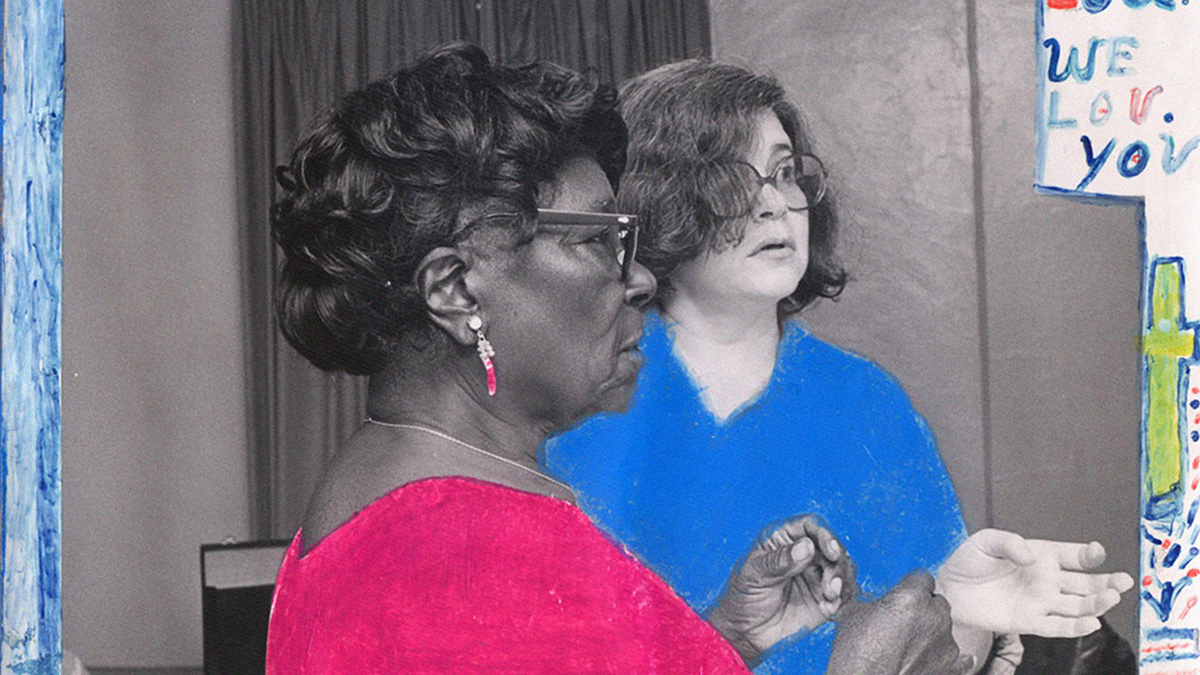
At the center of This World Is Not My Own is Rowe’s relationship with Judith Alexander, the gallerist who helped introduce her work to a wider art audience. The film recognizes Alexander’s role without allowing the familiar “discovery” narrative to overshadow Rowe’s decades of self-directed creation.
“We had to acknowledge Judith Alexander’s importance without making her the protagonist of Nellie Mae Rowe’s story,” hampton says. “Recognition matters, but it’s not the same as creation.”
That distinction matters because Rowe’s art existed long before the art world caught up to it. “History often remembers the people who discover artists,” hampton continues, “but the real story is that extraordinary artists exist long before they’re discovered.”
Ringbom was also interested in the historical complexity of Alexander’s Southern Jewish background in relation to Rowe’s Black Southern life. The film does not claim those experiences are the same; instead, it allows their points of connection and contradiction to remain complicated.
History as Landscape
The documentary places Rowe’s imagination against the historical forces she inherited: segregation, racial violence, disenfranchisement, and the social order of the early 20th-century South. For Ringbom, that context is essential. “We need to understand what is happening around her in order to understand her,” he says.
hampton puts it even more plainly: “You can’t understand Nellie Mae Rowe without understanding the world she inherited.”
Still, the film refuses to reduce Rowe’s art to trauma. “The film isn’t saying her art is reducible to history,” hampton says, “but it is saying her art didn’t exist outside of history.”
That balance is crucial to understanding Rowe’s enduring power. Her work is filled with humor, spirituality, dolls, color, and wonder, but those qualities become even more striking when considered against the brutality of the world around her. “The history deepens the art,” hampton says. “It doesn’t define it.”
The House as Masterpiece
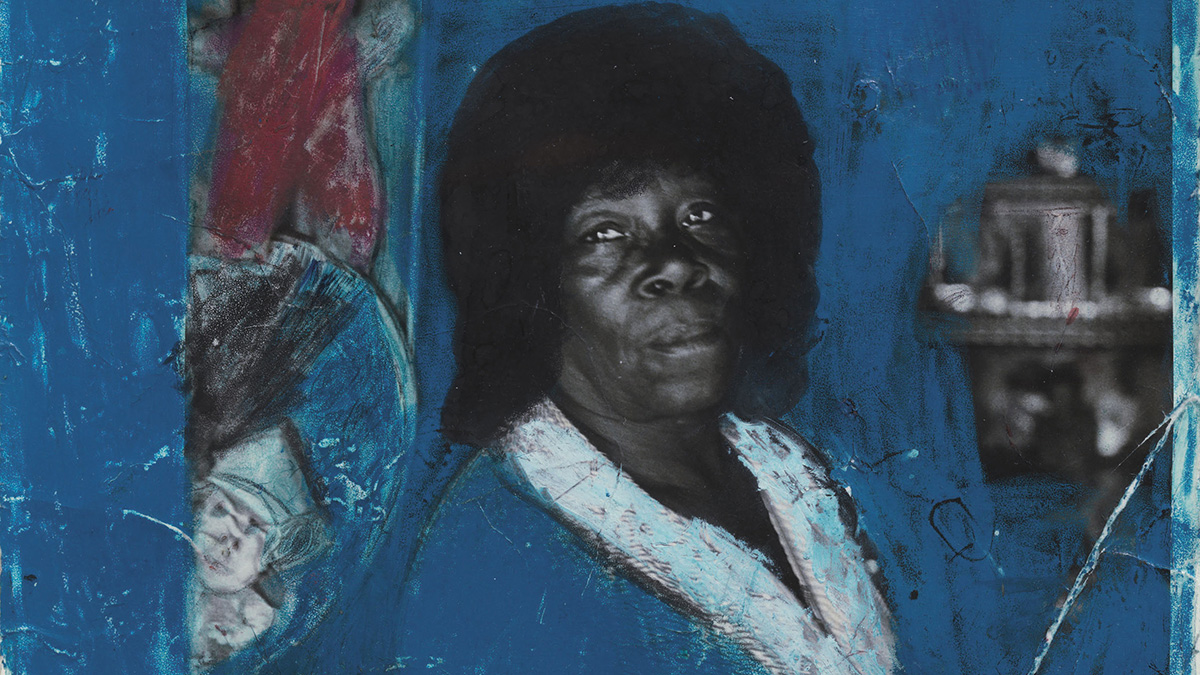
One of Rowe’s most radical creations was her home itself. Ringbom is careful to distinguish between recreation and reimagination. “It’s impossible to recreate her world,” he says. “Only she can make that world.”
The Playhouse was not static. It changed as Rowe changed, responding to her feelings, materials and daily inspiration. “It was a living, breathing thing,” Ringbom says. “What object would be added to it or removed and so forth.”
Because the house was demolished after Rowe’s death, the film’s reimagined sets carry a particular weight. “Probably her house was her most important work of art,” Ringbom says. The film, then, becomes a kind of memorial architecture: not a replica, but an invitation to feel what visitors once encountered.
hampton connects Rowe’s story to a larger pattern faced by outside and self-taught artists, whose environments are often misunderstood, threatened, or destroyed before institutions recognize their value. In that sense, Alexander’s advocacy became a bridge between Rowe’s world and the museums now charged with preserving her legacy.
Imagination as Liberation
Asked what Rowe’s life says to this moment, hampton turns to imagination as a form of freedom in Black culture. “Long before we had the language of Afrofuturism, artists like Nellie Mae Rowe were already practicing it in spirit,” she says.
Rowe’s vision was not escapism. “She wasn’t escaping reality,” hampton says. “She was enlarging it.” Her materials were humble—found objects, dolls, drawings, and the landscape around her—but her claim was vast: that a Black woman’s inner world deserved wonder, complexity, and space.
“The imagination becomes a place where freedom can be rehearsed before it’s realized,” hampton says. “She refuses to let the world have the final word about who she is.”
For Ringbom, the challenge of telling Rowe’s story was not a lack of material in the emotional or artistic sense, but an abundance of possible directions. “There are so many threads, and it’s always hard to know how to contain it,” he says. “There’s so much that she lived through and so much that she created that it could easily become a mini-series following her life.”
That sense of abundance may be the point. This World Is Not My Own does not present Rowe as a marginal figure being rescued by attention. It presents her as an artist who had already built a universe—and invites viewers to finally step inside.
Be’n Original