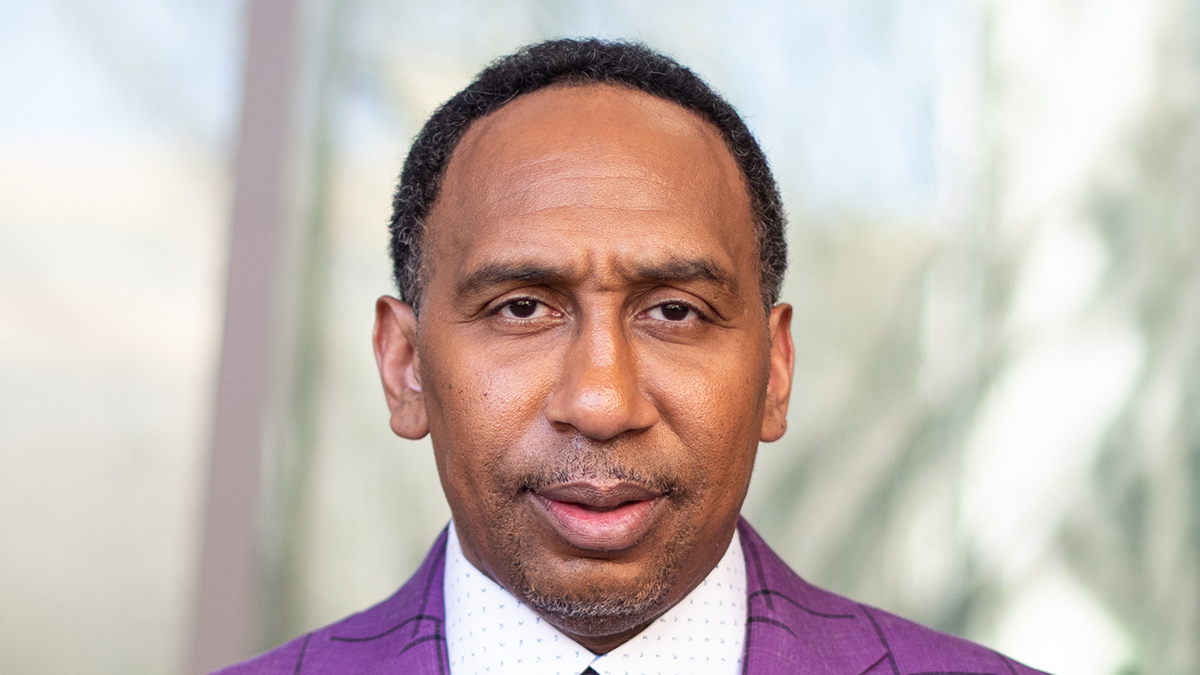
Stephen A. Smith insists he doesn’t have a problem with Black women.
After more than a decade of public controversies, however, the more pressing question may no longer be whether he believes that. The question is why so many Black women—from journalists to politicians to viewers—have independently reached the opposite conclusion.
Patterns matter.
Any public figure can have one bad day, one poorly phrased comment, or one disagreement with a colleague. Stephen A. Smith has certainly had all three. But when the same criticism surfaces repeatedly over the course of more than a decade, it deserves more than a dismissive wave of the hand. It deserves examination.
The pattern arguably begins in 2014.
During ESPN’s discussion of Ray Rice’s assault of his then-fiancée, Smith correctly stated that no man should ever hit a woman. Yet he undermined that message by telling women they should avoid doing anything that might “provoke” violence. The backlash was immediate because millions heard what domestic violence advocates have spent decades fighting: the suggestion that victims bear some responsibility for preventing their own abuse. ESPN suspended Smith for one week after he apologized publicly.
That controversy should have become a turning point.
Instead, it became the first chapter in a recurring story.
Fast-forward to 2024.
As women’s basketball experienced unprecedented growth, ESPN analyst Monica McNutt challenged Smith on First Take. Her criticism was straightforward. She argued that someone with Smith’s enormous platform could have devoted sustained attention to the WNBA years before Caitlin Clark transformed the league’s visibility.
Reasonable people can disagree with McNutt’s assessment. What stood out was Smith’s response.
Rather than simply debating her argument, he devoted extensive airtime to defending himself, listing the women whose careers he believed he had helped and portraying himself as one of the sport’s foremost advocates. The conversation shifted from the WNBA to Stephen A. Smith.
That response prompted another respected Black journalist, Jemele Hill, to push back.
Hill rejected Smith’s repeated implication that he deserved credit for the careers of Black women like herself, Monica McNutt, and Cari Champion. Her criticism wasn’t about disagreement. It was about ownership. Why, she asked in effect, was Smith positioning himself as the architect of women’s professional success rather than acknowledging their own accomplishments?
Again, the issue wasn’t simply criticism. It was the dynamic.
Then came Jasmine Crockett.
Smith questioned whether the Texas congresswoman’s outspoken political style was effective, describing aspects of her rhetoric as being “for the streets.” Political commentary is fair game. Crockett is an elected official, and every politician should expect scrutiny.
Yet what followed is telling.
After receiving widespread criticism—including from Black women who argued he had unfairly caricatured Crockett—Smith issued an apology. He acknowledged that his comments could provide ammunition to people already attacking outspoken Black women in politics. In other words, he recognized that his words carried consequences beyond his original intent.
If these incidents existed in isolation, they might not warrant broader discussion.
But they do not exist in isolation.
Over the years, Smith has also drawn criticism from Black women over his commentary on Black women voters, his responses to Joy Reid, his disputes with former colleagues, and the recurring tendency to become defensive when Black women publicly challenge him. The names change. The circumstances change. The criticism remains remarkably consistent.
To be fair, Stephen A. Smith criticizes men, too. He has built an empire on criticism. No serious observer should argue that Black women are the only people who find themselves in his crosshairs.
But frequency alone isn’t the only measure of a pattern.
The more revealing question is whether there is something distinct about his interactions with Black women. Too often, those exchanges evolve from substantive disagreements into lectures about credibility, reminders of his influence, or defenses of his own record. The conversation stops being about the issue and starts being about Stephen A. Smith.
That is precisely why the criticism persists.
It also explains why so many Black women who have never coordinated with one another arrive at similar conclusions. Monica McNutt was discussing media coverage. Jemele Hill challenged professional narratives. Jasmine Crockett responded to political criticism. Joy Reid questioned broader cultural dynamics. Different women. Different professions. Different contexts. Similar concerns.
None of this proves that Stephen A. Smith dislikes Black women.
It does suggest that he has repeatedly struggled to hear criticism from Black women without responding in ways that reinforce the very concerns they are raising.
Perhaps the most revealing aspect of this history is not that controversies continue to occur. Public commentators inevitably generate controversy.
It is that, after each episode, Smith tends to frame himself as the misunderstood party. Critics are accused of twisting his words, ignoring his accomplishments, or refusing to acknowledge everything he has done for Black women. Missing from that narrative is sustained self-examination about why these disputes recur with such regularity.
At some point, the burden shifts.
When one controversy follows another for more than a decade, it becomes less persuasive to argue that every critic misunderstood the assignment. The simpler explanation may be that people are observing the same behavior from different vantage points.
Stephen A. Smith may genuinely believe he champions Black women.
The historical record suggests that many Black women remain unconvinced.
That disconnect is itself the story.
Be’n Original