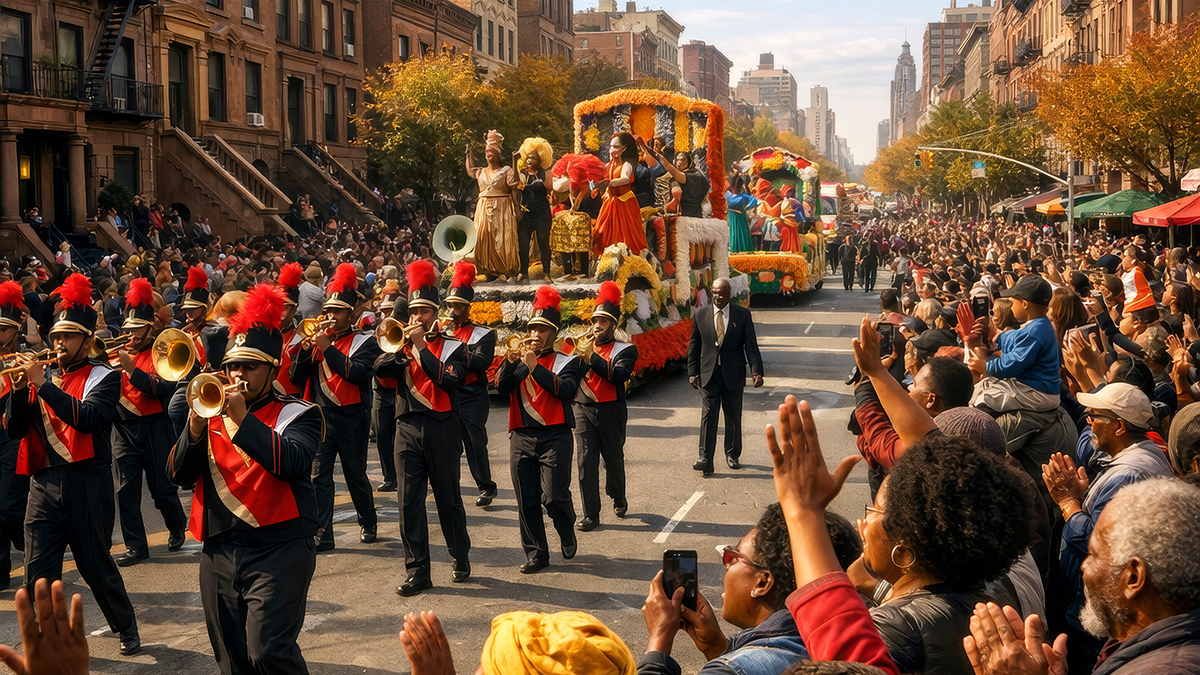
From the beginning of African-descended people becoming Americans, being Black in America has come with its share of trials and triumphs. There are histories that hurt, histories that heal, and, thankfully, histories that remind us to celebrate simply because we can.
For 57 years—yes, fifty-seven—Harlem has been doing exactly that.
On Sunday, September 20, the African American Day Parade returned to Adam Clayton Powell Jr. Boulevard. The streets were filled with marching bands, floats, performances, community organizations, Black-owned businesses, and people who apparently did not receive the memo that rain was supposed to ruin the party.
Founded in 1968 by Afro-American Day and the United Federation of Black Community Organizations, the parade began when 13 community organizers created a space for Black Americans to celebrate their heritage, talents, and accomplishments while honoring those who came before them. The first parade followed in 1969 under the theme “Africa’s Gift to America,” with Adam Clayton Powell Jr. and Shirley Chisholm serving as grand marshals.
The inaugural parade drew more than 100,000 marchers, 160 Black organizations, and approximately 200,000 spectators. By 1975, the viewing audience had surpassed 900,000. Over the decades, the parade has also served as a place for civic engagement, including a voter registration drive launched in 1980.
That is a lot of Black people deciding, year after year, that there is something worth celebrating for the love of it.
Today, the parade remains a community-centered production led by African American Day Parade, Inc., with Chairman Yusuf Hasan at the helm. Its 2026 partners included the Apollo Theater, Northwell Health, Mount Sinai, the Schomburg Center for Research in Black Culture, the NAACP, WBLS, Black Greek letter organizations, and others.
Then, down came the rain that couldn’t stop Harlem’s shine.
The saying “don’t rain on my parade” exists for a reason. For Black people, that inconvenience can carry a deeper history. Water has been part of stories of escape from bondage, violence against our ancestors, and generations of complicated relationships with swimming. Even today, rain can mean watching a good moment [and hairdo] surrender to the elements.
This year’s theme, “Good Businesses Sustain Our Future,” put Black entrepreneurship and economic strength at the center of the celebration. More than 35 floats and 300 performances filled the streets alongside marching units and community organizations.
“Rain did not stop our ancestors,” Hasan said. “They did not stop civil rights. So, we’re not going to let a little rain stop us.”
Like Juneteenth, which grew from a regional celebration into one recognized across the country, the African American Day Parade reminds us that Black history is still being made and honored beyond February.
After everything, we see the rain and dance in it anyway.
The next African American Day Parade is expected to return to Harlem on the third Sunday of September 2027. To keep up with registration, community events, and parade announcements, visit the African American Day Parade’s official website.