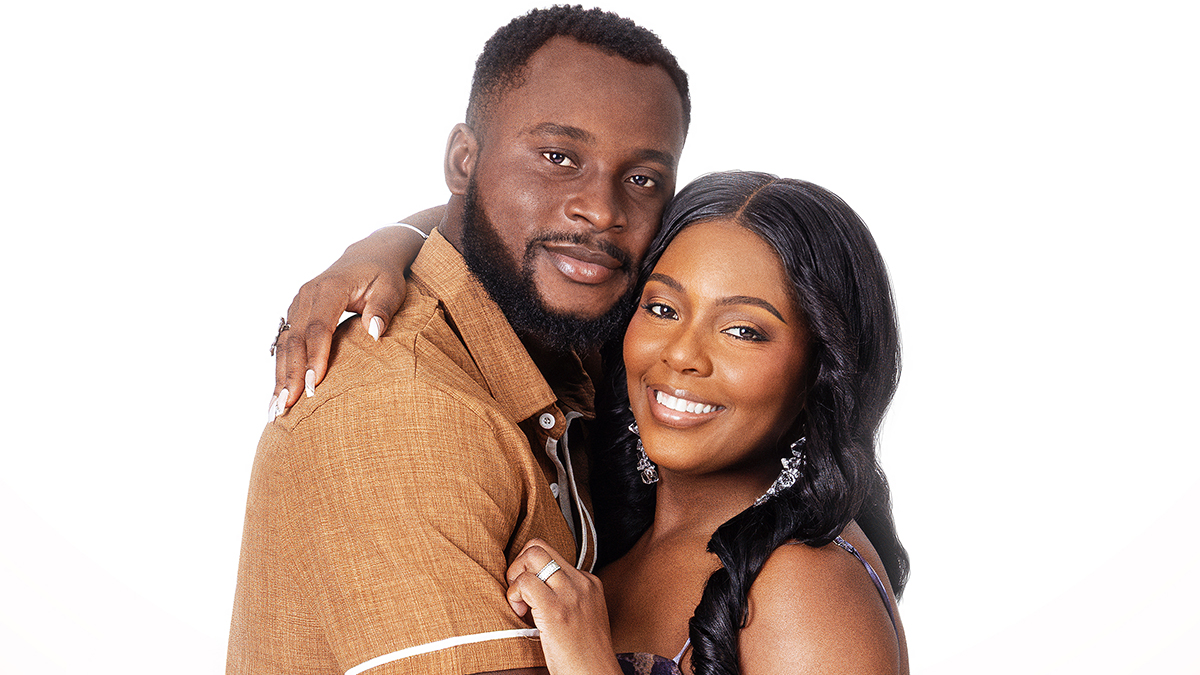
Ashia Montgomery shares her heartfelt journey of discovering love with Maxwell on the reality show 90 Day Fiancé. She delves into the nuances of their significant age difference, the role of faith in their relationship, and the skepticism expressed by both their families and viewers.
Additionally, she explores the cultural contrasts that shape their connection and the intricate visa process that poses challenges to their future together.
Society often pressures women as they age to rush love, marriage, and family. What gave you the confidence to seek love on your own terms instead of yielding to that pressure?
I feel like you just have to trust God and trust God’s timing. He orchestrates everything. He knows the beginning, the end—he knows it all. As long as you’re in His will, you’re patient, and you’re prepared, I feel like God is going to do His part. He’s going to bring that man.
Faith is clearly an important part of who you are. How has that influenced the way you approached your relationship with Maxwell?
The biggest thing is that we’re both Pentecostal. We have the same religion, so we have the same foundation. When it comes to those things, I feel like we can definitely relate. I think it’s very important to be equally yoked with a person and to have a good understanding when it comes to the Word and applying the Word. That’s the biggest thing.
How do you distinguish between having faith in a relationship and simply hoping things work out?
I’m big on red flags. If you show me a red flag, baby, I cut you off real quick. I think you also have to have wisdom. How is this person treating me? How does this person make me feel? Is this somebody I can be with long-term?
Sometimes, as women, we settle. We get anxious and impatient and think, “This is kind of OK. I can work with this person.” But I think the biggest thing is making sure you can fulfill God’s will with that person.
What was it about Maxwell that made you realize the relationship was worth taking such a big leap of faith?
Initially, it was finding out that we had the same religion. Then after my first visit, I watched how he interacted with people—because, baby, I was watching. My eyes were open. I wanted to make sure this guy lined up with what he had been telling me. I watched how he treated people, how he treated the waitstaff, and how he interacted with his friends and his family. We had such a short amount of time to spend together, so I was really paying attention.
Between our similarities, our religion, and seeing that his actions lined up with what he was saying, that meant a lot to me.
Both your family and Maxwell’s family have questioned some of your decisions and the pace of the relationship. What was it like dealing with uncertainty from the people closest to you when you were hoping for their support?
It’s annoying, because I’ve already made my decision. At that point, what you’re looking for is support. I feel like I’m intelligent. I feel like I have a lot of wisdom, and then I have God. I have a strong gift of discernment, so I know when something is right for me and when something is wrong for me. It’s aggravating when people who have known me all my life know that nine times out of ten, I make great decisions. Why would you think I would drop the ball on something so important?
I know people talk about age, menopause, and all of those things, but I wouldn’t rush into a decision because of my age or because of a fear that I might not be able to have children.
What do you think your families were seeing that made them question the relationship?
The biggest thing is that when you’re dating someone and you don’t see them all the time, you don’t really have certainty. What are they doing? Do they have another girlfriend over there? What are they doing when you’re not together?
And how can you really know someone if you’re not spending a lot of time together? I’m big on that. I do feel like you need to see a person in all seasons. You need to see how they are when they’re angry, when they’re sad—you need to see all of that. At the same time, I had to rely on the fact that I felt like God told me this was my person. I had to have faith that I heard God correctly.
You and Maxwell have a 10-year age difference. Has that become a major part of the conversation surrounding your relationship? And what do you wish people understood about the two of you that they might not see from the outside?
A lot of people thought I was bossy, first of all. They thought I was pretty bossy. I don’t feel like I’m bossy, per se. I just know what I want, and I know how I want things. If I think the way I’m doing something is going to benefit you, I’m going to try to get you to go in that direction. That’s just my personality. As far as the age difference, if Maxwell is okay with the age and Ashia is okay with the age, why should it be a problem for somebody else? We chose each other. Let us be happy with our choice.
There have been several obstacles standing between you and the future you envisioned with Maxwell, from the visa process to outside criticism. Which challenge has been the hardest emotionally?
That visa. Hands down, that visa. I already knew what God said. I knew what His promise was, so I had already imagined this man in the U.S. We had this beautiful home, these careers—I had already envisioned so many things. It never crossed my mind, even for a split second, that the visa would be denied. That rocked my world. I was not prepared for that one.
Out of everything, that has been the hardest thing to deal with.
Has the difficulty with the visa changed how you and Maxwell approach your future?
I think it has taught me to always have a solid Plan A, but also consider the what-ifs. And be prayed up. Originally, we were praying really, really hard about the situation. But as time went on, because the process took so long, we got comfortable. Instead of continuing to fast and pray that everything would work out, we became so confident that we were going to get an approval. So my thing now is: always have a backup plan, and be prayed up.
What have you learned about yourself throughout this journey, whether about your faith, relationships, or interacting with people from another cultural background?
I feel like all my life I’ve been around a lot of different cultures, especially when I was in pharmacy school. I’ve always felt like I know how to conduct myself around anybody. I know how to make people feel comfortable and welcome, no matter their background or culture. I can embrace it. The hardest thing for me was when I said one wrong thing—I didn’t say “good morning”—and viewers tore me up for that. People were saying I didn’t know how to embrace other cultures or that I didn’t respect other cultures. That was so far from the truth. It’s something I’m still dealing with to this day. I still get comments about that one.
As you’re learning Maxwell’s culture, what has required the two of you to really work on how you communicate?
The biggest thing when you’re trying to communicate and learn is patience. Don’t think it’s going to be instant. You have to be a good listener. I talk more than I listen, unfortunately. But you have to listen, you have to be teachable, and you have to try to be compassionate.
Sometimes you get so used to the way you do things that you think, “Whatever, that’s not important.” You brush something off and say, “I know, I know, I know.” But you really need to listen to what the other person is saying. When you’re listening, you’re teachable and you’re open to new experiences, things go a little more smoothly.
You’ve described your journey as proof that it’s never too late to find love. What would you say to someone watching your story who has started to believe love has passed them by?
Love can never pass you by. I feel like the biggest thing is being prepared. Pray to God and let God know the desires of your heart. Delight yourself in the Lord, make sure what you want lines up with His will, and then be prepared. I wasn’t prepared. I needed to cook a little bit more and learn a few more recipes. I needed to be a little tidier. There were a lot of things I needed to work on to be prepared for this man, and I wasn’t. Now I’m getting a crash course.
A lot of women are so fixated on, “Where’s the man? Where’s the man? Where’s the man?” instead of asking, “What do I need to work on? How can I strengthen my relationship with God?” I feel like God will answer those prayers.
Na’ilah Burston