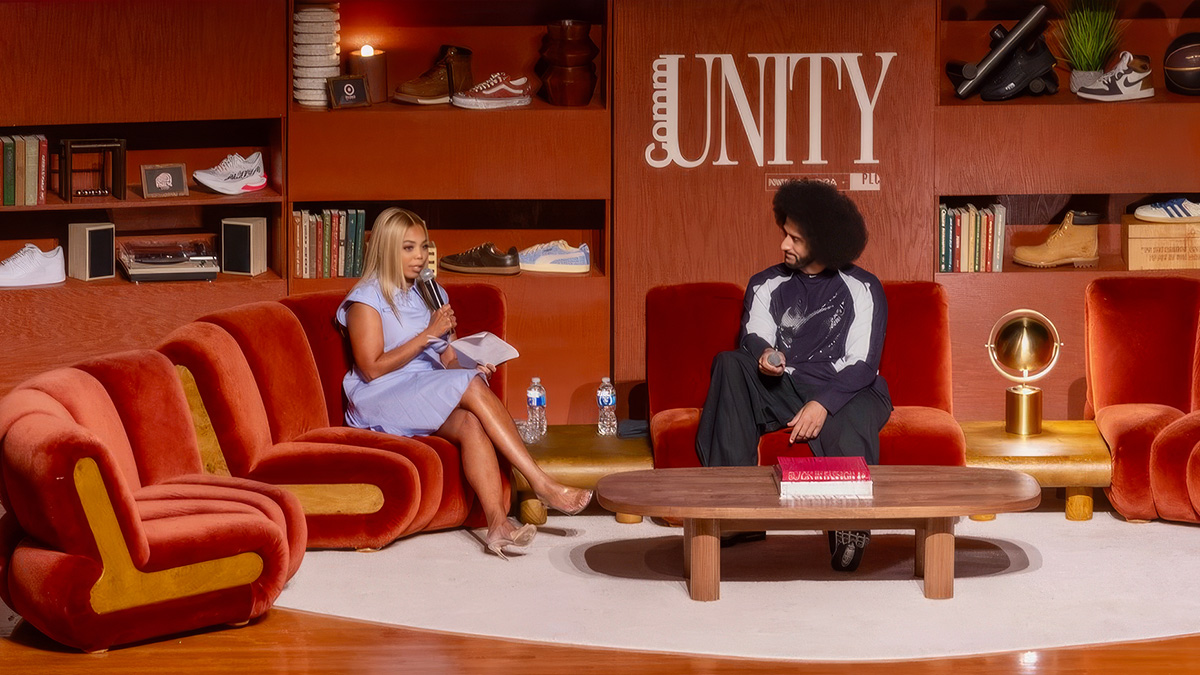
The seventh annual forum at PLC Detroit connected footwear, culture, creativity, and legacy through four days under the theme “Rooted in commUNITY”
For nearly a decade, the image of Colin Kaepernick taking a knee has remained one of the most recognizable and debated moments at the intersection of sports, race, and activism.
That conversation found its way to Detroit during the seventh annual Black Footwear Forum (BFF), held Sept. 10-13 at Pensole Lewis College of Business & Design (PLC Detroit), where more than 1,000 attendees came together for four days of conversations, professional development, networking, and brand activations under the theme “Rooted in commUNITY.”
Powered by PLC Detroit and the Footwear Distributors and Retailers of America (FDRA), the footwear industry’s business and trade association, BFF was created to celebrate and safeguard Black influence, leadership, and creativity in the global footwear industry while expanding access and opportunities for Black professionals and emerging talent.
The forum brings students and emerging creatives into the same space with designers, executives, industry professionals, and cultural leaders to exchange knowledge, build relationships, and address representation.
But BFF has also become a place where footwear serves as the starting point for larger conversations about the culture and communities that have helped shape the industry.
Kaepernick and Detroit native journalist and cultural commentator Jemele Hill brought another dimension to that conversation.
Sitting across from Hill during one of the forum’s most anticipated sessions, the former San Francisco 49ers quarterback had an opportunity to go beyond the familiar image of him taking a knee and share his perspective on the experiences that shaped him, the events surrounding his protest, and why his fight to return to professional football still matters.
Their discussion explored race, identity, family, and Kaepernick’s experiences growing up as a Black child adopted by white parents, his protest, and the professional consequences that followed. It gave the audience an opportunity to hear directly from Kaepernick about experiences that helped shape his understanding of himself and, ultimately, the positions he would take publicly.
Within a forum centered on “Rooted in commUNITY,” the conversation offered another way to consider what community can mean—identity, belonging, using one’s platform, and standing behind convictions when the consequences become personal.
His decision to protest in 2016 was rooted in concerns about racial injustice and police brutality. What began as an individual act of protest quickly became a national conversation about race, patriotism, professional sports and the role of athletes who use their platforms to speak about issues affecting their communities.
Nearly a decade later, Kaepernick also addressed why his desire to return to professional football remains important to him.
“I don’t think anyone should have their career taken from them for fighting for us,” Kaepernick told the BFF audience.
That statement gave the audience something larger to consider.
His comments suggested that his desire to return to the NFL is connected to more than whether he plays another football game. They raised a broader question about the professional price people can pay when they use their voices to advocate for their communities.
That question can resonate well beyond sports. The BFF audience included designers, entrepreneurs, executives, students, and emerging creatives building careers in industries where challenging established systems, speaking up and standing behind one’s convictions can carry professional consequences.
In that sense, the Kaepernick-Hill conversation illustrated another side of commUNITY.
Community is often discussed in terms of support, networking, mentorship, and creating opportunities for others. But community can also require something more difficult: deciding what you are willing to stand for when the issue extends beyond your own individual interests.
Kaepernick’s story gave the audience an opportunity to consider that question without requiring everyone in the room to reach the same conclusion.
Hill was an especially fitting person to guide the discussion. A Detroit native whose career has examined the intersections of sports, race, culture, and politics, Hill helped create space for Kaepernick to revisit a story that has been interpreted through years of headlines, television commentary, and public debate.
At BFF, the audience had an opportunity to hear his perspective directly. That exchange was particularly relevant within a forum built around the idea of commUNITY. There is value in creating spaces where people can share their experiences, where history can be heard from those who lived it and where the next generation can listen, question, and form its own understanding.
Kaepernick and Hill’s conversation was one of several throughout the four-day forum that demonstrated how BFF extends beyond footwear into the people, experiences, and cultural movements that have shaped it.
Darryl “DMC” McDaniels of Run-DMC discussed hip-hop, transformation, and cultural influence. Streetwear pioneers April Walker and Detroit native Maurice Malone brought decades of fashion history into the room. Author and executive leader Shaka Senghor spoke about resilience and the ability to turn setbacks into strength.
Different industries. Different experiences. Different perspectives. Yet each conversation demonstrated what can happen when knowledge and lived experience are shared across generations.
Kaepernick and Hill’s discussion pushed that idea into particularly complex territory by asking the audience to consider the relationship between identity, conviction, community, and consequence.
The timing of Kaepernick’s appearance also carried significance. His memoir, The Perilous Fight, was scheduled for publication Sept. 15, nearly 10 years after his protest became a defining moment in sports and culture. The book provided additional context for portions of the conversation, including experiences from Kaepernick’s upbringing and his evolving understanding of race and identity.
But what unfolded on the BFF stage was larger than a conversation about a book.
It was an opportunity to hear from someone whose personal decision became part of a much broader cultural debate and to consider what happens when individual conviction collides with professional consequence.
It also demonstrated why a conversation like this could have a place at the Black Footwear Forum.
BFF is rooted in footwear, but footwear has never existed separately from the culture surrounding it. Sports, hip-hop, fashion, and identity have influenced the industry for generations. The people wearing the products, creating the trends, and shaping the culture are part of the story, too.
Perhaps that was one of the clearest observations to emerge from BFF 2026: commUNITY is not simply about bringing people into the same space. It is about creating a place where experiences can be shared, history can be examined, different perspectives can be heard, and the people coming behind can leave with a deeper understanding of what came before them.
For one afternoon in Detroit, Kaepernick and Hill did exactly that.
Their conversation gave the BFF audience an opportunity to look beyond a familiar image of an athlete taking a knee and hear more of the story from the person who lived it.
Nearly a decade later, the discussion also offered another way to think about being “Rooted in commUNITY”: Sometimes community is about who stands with you. Sometimes it is about who you choose to stand for.