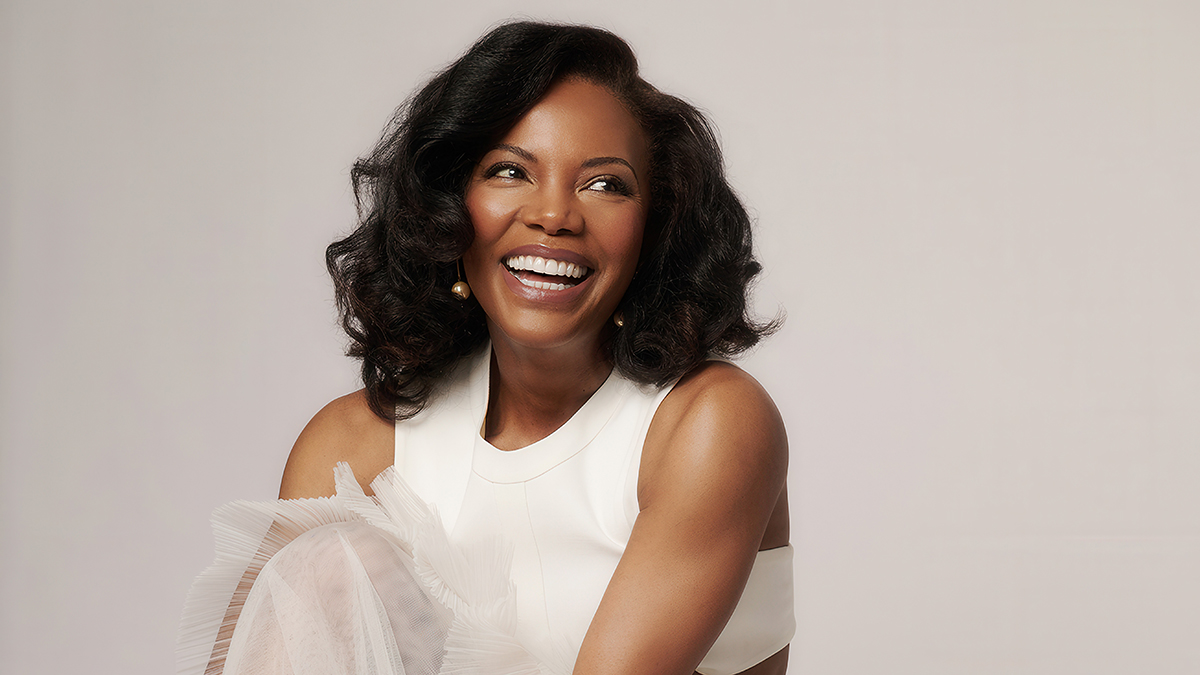
From scene-stealing moments on “Ruthless” to creating stories that challenge assumptions on and off the screen, Nadège August has built a career defined by curiosity, range, and fearless authenticity.
Joan began as a recurring character on “Tyler Perry’s Ruthless” before becoming a series regular. Looking back, what do you think resonated with audiences and the creative team, allowing the character to evolve in such a significant way?
Looking back, I think Joan represented a type of Black woman who isn’t often celebrated or highlighted—the Black nerd. She’s quirky, values civility, and has a certain sophistication. When I was invited back as a series regular, I was told, “We’ve never had a character like you on any of our shows before. We really love what you’re doing.” I think that’s what resonated.
One thing I love about Joan is that you’re never quite sure what she’s thinking or where she’s headed. That’s how human beings are. We all believe we’ll react a certain way when we’re confronted with difficult situations, but our responses often surprise even ourselves. I try to bring that unpredictability to every character I play. I’ll share a funny story. Joan was originally supposed to die during the COVID-era season. Tyler Perry Studios had figured out how to keep productions going during that frightening time, and we actually filmed the scene where Joan takes her own life.
Months later, after production had wrapped, I got a call telling me they had decided not to use the scene and would simply continue her story instead. It was such an unexpected gift. Not many actors can say they literally filmed their character’s death and then came back as a series regular.
Season six raises the stakes with fractured loyalties, mounting FBI pressure, and shifting power within the compound. Without giving away spoilers, what can viewers expect from Joanís journey, and how has she changed since audiences first met her?
Joan develops a backbone. She discovers a strength that even she didn’t know she had. Within the world of the cult, trust is always fragile. No one is entirely who they seem to be, and Joan has become very skilled at navigating different alliances. She’s learned how to survive by understanding the people around her, adapting as circumstances change.
Joan is often described as the quirky accountant, but thereís much more beneath the surface. What aspects of her personality have you enjoyed exploring the most?
I’ve really enjoyed exploring what brought Joan into the cult in the first place. Beneath everything is an enormous amount of vulnerability and pain.
It’s interesting because I think we’re living through a time when so many people are searching for certainty. When people feel insecure or lost, they’re often more vulnerable to manipulation and indoctrination.
Joan reflects that reality. Understanding what drove her to become so deeply invested in something that ultimately became a nightmare gives her a powerful survival instinct.
You recently completed work on the independent short film ìThe Long Dark Climbî alongside Eric Roberts. What drew you to the role, and how did the project challenge you creatively?
It couldn’t have been more different from Joan. We wrapped “Ruthless,” and about two weeks later I jumped into this project. I play a doctor who is heavily pregnant while trying to save lives during a disaster. Much of the film takes place inside Chicago’s underground train system after an earthquake causes water to flood the tunnels.
A lot of the work involved green-screen acting, so I had to physically imagine being trapped underwater and fighting for survival. It was incredibly demanding, both physically and emotionally, and that’s what made it so rewarding.
What first inspired you to pursue a career in acting?
Acting has always felt like a calling. I’m actually an introverted extrovert. In most situations, I’m quiet and happy to observe. But I’ve always loved words. As a child, I read constantly and became completely immersed in the worlds of the characters. I’d find myself reading their dialogue aloud, giving each character a different voice, feeling their joy and their pain. I didn’t even know that was called acting. When it came time to choose a college major, I told my parents I wanted to study acting. As immigrants, they couldn’t understand it. They knew careers like doctor, lawyer, engineer, or nurse—not acting.
The school I attended didn’t have an acting program, so I majored in communications because broadcast journalism seemed like the closest thing to performance. After graduating, I earned my MFA in theater. I’ve always needed that creative outlet. When work slows down, I feel it. That’s why I return to theater whenever I can. Acting is therapeutic. It gives you permission to experience emotions that everyday life doesn’t always allow. Through a character, you can explore joy, grief, fear, or anger honestly. And when audiences witness that emotional truth, they often feel permission to experience those emotions alongside you.
You’ve built a career across theater, television, film, digital media, podcasting, and writing. How does moving between those creative spaces keep you inspired?
Creativity isn’t optional for me—it’s necessary. If I’m not creating something, I genuinely feel like a part of me isn’t fully alive. When I’m not acting, I enjoy connecting with people through my podcast, asking questions and discovering ideas I hadn’t considered before. Writing is another important outlet, and it’s something I want to devote more time to. The industry has been slower since the strikes, so I’m using this time to return to a writing project I’ve been developing with guidance from a mentor.
I also recently became certified as an intimacy coordinator. That training opened my eyes to conversations about boundaries, implicit bias, and workplace power dynamics. I’m a lifelong learner. I love discovering new ways to grow within this profession.
What surprised you most about becoming a certified intimacy coordinator?
The biggest surprise was how intentional the entire process is. Before any intimate scene is filmed, detailed conversations happen with each performer about boundaries, consent, and exactly what they’re comfortable showing on camera. Everything is discussed beforehand. The other surprise was the modesty garments actors wear. People often assume intimate scenes are spontaneous or physically authentic, but they’re highly choreographed. Those garments eliminate physical contact, and the scenes are carefully blocked like dance choreography.
Every movement is planned. Every touch is discussed. Every camera angle is designed to respect the actors’ boundaries while serving the story. I hadn’t realized just how much preparation and care goes into those scenes.
You spent your childhood between Brooklyn, France, and Haiti, and youíre fluent in English, French, and Haitian Creole. How have those multicultural experiences shaped the stories youíre drawn to and the characters you portray?
I encourage every parent, if possible, to have their children learn a second language. Research has shown that multilingualism changes the way we think. For me, seeing the same object represented by three different words reinforced the idea that there are always multiple perspectives. Nothing is completely absolute. That carries directly into my acting. I never believe there’s only one way to interpret a character or a scene. I’m always looking for another possibility, another emotional truth.
Growing up in Brooklyn, France, and Haiti also exposed me to different cultures, foods, music, languages, racism, and colorism. When I was younger, I sometimes wished I’d had a more traditional upbringing because all you want at that age is to fit in.
Looking back, though, I’m grateful. Those experiences gave me a much broader understanding of people, and I bring that perspective to every role.
Your web series “Bougie Dilemma” and your podcast “What the Fockery” highlight your voice as both a performer and a storyteller. What motivates you to create your own projects instead of waiting for opportunities?
“What the Fockery” grew out of my own curiosity. I love asking questions. I donated more than 375 books to a library one day and realized I didn’t have to read everything myself anymore. Instead, I could simply ask people about their experiences. Whether someone was talking about gender identity, unconventional relationships, or an unusual profession, I’d find myself thinking, “What is that?” So I started inviting those people onto the podcast.
One of my favorite interviews was with a numismatic artist—a person who designs currency. I had never even considered that someone had to create the artwork for coins and paper money until I met him. The podcast became a way to satisfy my curiosity while giving other people an opportunity to share perspectives I might never have encountered otherwise.
“Bougie Dilemma” was different. I created it as a proof of concept, hoping it would develop into something larger. It didn’t, and that’s okay. Not every project succeeds. You have wins and losses, and sometimes the losses teach you the most.
Be’n Original