
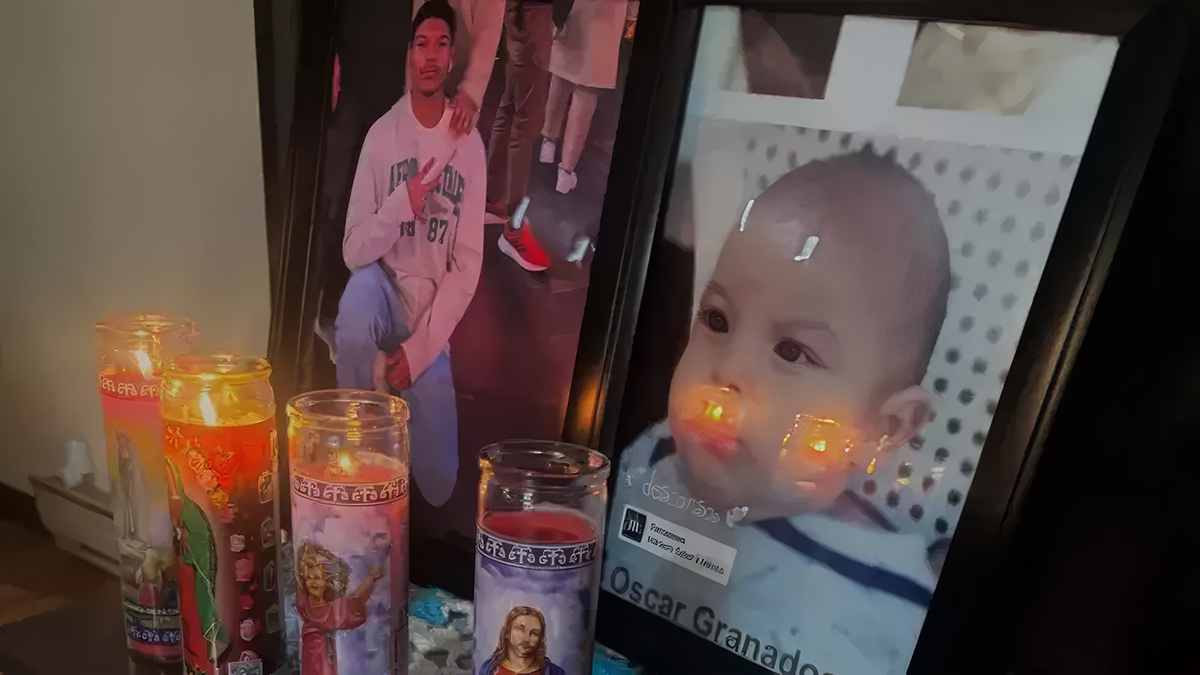
Newly released body-camera footage of police fatally shooting a 17-year-old in Wappingers Falls is raising questions from his family about whether his movement toward an officer posed an immediate threat that warranted deadly force.
Oscar Granados Colindres was shot June 27 after police responded to a 911 call reporting a suicidal person. Officers found the teenager on the ledge of the Wappingers Falls Creek Bridge and spent about 50 minutes talking with him before the shooting, according to the New York attorney general’s Office of Special Investigation.
The attorney general’s office said Colindres had a knife and “allegedly ran toward at least one officer while holding the knife.” Multiple officers then fired their weapons, striking him. He was taken to a hospital, where he died. Authorities said a knife was recovered at the scene.
But footage released Sept. 30 has prompted Colindres’ family to question that account, particularly whether his final movements showed that he intended to attack an officer.
The videos show Colindres sitting on the bridge railing as an officer speaks with him. Near the end of the encounter, Colindres gets down from the railing and moves toward an officer standing nearby. Officers begin firing almost immediately.
The Times Union reported that police shot Colindres within about one second of him coming down from the railing and moving toward the investigator. The footage does not clearly show a knife in his hand at the moment officers open fire, although an officer can be heard discussing a knife with Colindres before the shooting.
That distinction is now at the center of questions raised by attorneys representing Colindres’ family.
The attorneys said the footage does not clearly establish whether Colindres was holding a knife when he was shot or whether he was moving toward the officer in a threatening manner.
“The family’s understanding of the footage is that Oscar rose from the bridge ledge and took only a few steps, with his hands at his sides, before officers unleashed a barrage of gunfire,” the family’s attorneys said in a statement reported by the Times Union.
The family also questioned whether Colindres could have been trying to move away from the bridge rather than attack an officer.
WAMC reported that the footage appears to show Colindres getting off the ledge and taking a few steps forward before officers shoot him. The news organization reported that the video does not establish whether he was holding a knife at that moment or whether his movements were threatening.
The attorney general’s description and the family’s interpretation underscore a question that investigators will likely examine: what officers perceived during the seconds between Colindres leaving the railing and the decision to fire.
The footage also shows officers positioned around the area after spending nearly an hour communicating with the teenager. One officer appears to attempt to use a Taser as other officers fire their weapons, according to the Times Union.
Colindres’ family has also questioned the response to what began as a mental health emergency. His mother said she believes her son would still be alive if trained crisis intervention professionals had responded alongside or instead of police.
The state attorney general’s Office of Special Investigation is examining the shooting. Under New York law, the office investigates incidents in which a police or peace officer may have caused a person’s death.
The investigation remains ongoing. The attorney general’s office said release of the body-camera footage was intended to increase transparency and does not represent a determination about whether the officers’ actions were justified.
This version deliberately makes the disputed few seconds the central issue rather than treating the police characterization that he “ran toward” officers as an established description of what the video shows.